
After months of anticipation, I finally made it to Iraq! From the outset, I sensed it would open my eyes in ways I couldn’t predict – and it has. It’s been an experience I’ll never forget with stories of hope, kindness, and humanity that I can only begin to capture here.
Even with years of travel behind me, I was nervous about coming to Iraq. Canada’s travel advisory literally says “avoid all travel.” My own notions were of war, danger, run-down cities, and uncertain people. Even in other Islamic countries, I was told, “Don’t go to Iraq. You might not come back.”
But social media painted another picture. I found travellers posting videos of kindness, beauty, and joy. Strangers treated like family, wide smiles, shared meals. It was the opposite of the fear-based narratives.
Now, after weeks walking through cities, meeting people, and sharing meals, I can say Iraq is one of my favourite places yet. Here, hospitality isn’t the exception – it’s the norm.
Why Iraq?

So, how did I end up here?
Back in Edmonton, I’ve been mentoring a boy named Abdallah through Big Brothers Big Sisters. His family, who are Shia Muslim, welcomed me into their mosque and community long before Iraq was even on my radar. Over time, they became my second family.
They invited me to join them on the Arbaeen pilgrimage in Iraq – a deeply spiritual destination for Shias. I knew nothing about Arbaeen and little about the Shia faith, but with an invitation from people I trusted dearly, I couldn’t say no.
And now, having walked it with them, I can honestly say that it’s been one of the most transformational experiences of my life.
The Arbaeen Pilgrimage

Pilgrims walk through the near 50 degree heat.
Arbaeen means “forty” in Arabic. It marks 40 days after Ashura, the day Imam Husayn ibn Ali (Prophet Muhammad’s grandson) was martyred at Karbala in 680 CE. In Islamic tradition, forty days is the standard mourning period.
Each year, over 20 million people make pilgrimage to Karbala, making it the largest gathering in the world. The most common path is walking the ~80 km from Najaf to Karbala, usually over 2–3 days. Pilgrims honour Imam Husayn as a symbol of justice, sacrifice, and resistance to tyranny. For many, his story isn’t just history, but a living reminder to stand up for what’s right.
Though the majority of pilgrims are Shia Muslims, people of all backgrounds also join, drawn by the message of solidarity and unity. Despite the massive crowds, the atmosphere was remarkably peaceful. I didn’t witness a single argument or threat.
Three months in Morocco taught me a lot, but it was time to move on. Inshallah, I’ll be back.

Along the route, all necessities are freely provided. While some government support exists, most of it comes from ordinary people’s generosity. Families save all year to offer food, water, or services during this week. Mawkebs are tents or roadside booths that line the way, staffed by volunteers. They give pilgrims meals, tea, places to sleep, even showers and medical care. No payment is ever asked as it’s done as devotional service.
My Experience

As soon as I landed in Baghdad, acts of kindness began unfolding. My taxi driver shared his breakfast with me. On the shared van from Baghdad to Najaf a father-and-son insisted on paying my fare, saying, “this isn’t my money, but comes from Imam Husayn.” Although my guard was heightened in such a foreign land, kindness quickly cracked it open.
I hadn’t booked a hotel in Najaf, and despite the large crowds, I wasn’t worried. My Canadian family had told me free places to stay are everywhere during Arbaeen. I was introduced to a friend from Iran who said “you’re under my care here”. He made sure I found a comfortable place to stay and remained by my side.
And then, being reunited with Riffat, Abdallah, and Ali Akbar – familiar faces that I hadn’t seen in a year – surfaced overwhelming gratitude and feelings of home.

Heat and crowds were the hardest parts. Daily highs neared 50°C with nights in the mid-30’s. To compensate, we walked mostly at night and slept during the day to avoid the worst of the heat. Millions of people were crammed into spaces designed for much fewer, but no one complained. Any discomfort was shared and served as a reminder of the hardships many have faced before us.

The roads remained full all night.
Walking from Najaf to Karbala the road was alive at all hours: lined with lights, loudspeakers with recitations or chants, children well-wishing, and volunteers passing bottles of water and food. At night the walk seems endless but beautiful.
During this mourning period, it’s customary to wear black. Yet the mourning goes beyond symbolism and could be felt in the air, in the chants, and in the tears. For me, this was the deepest culture shock of my travels – the complete immersion into a collective grief and system of faith that I wasn’t a part of. I was surrounded by people who were connected in ways I didn’t understand. Though I felt out of place, I was also wholeheartedly welcomed.

A group carrying Canadian flags.
The pilgrimage was also full of human stories. I met people from across the world, all walking side by side without hierarchy. For a moment, I glimpsed what a world without borders might look like with people united by something greater than nationality.
I listened to accounts of how decades of turmoil had shaped lives. Some had fought ISIS, others had lost homes, others longed for safety or a chance to start over. Hearing them, I realized how oversimplified our narratives about war and geopolitics often are. While the media casually mentions bombings or interventions, here I was, face to face with the people who lived on the receiving end of those decisions.

Near the end of the walk, I spent a few days volunteering in a mawkib. Each day they turned fifty melons into smoothies and made hundreds of chicken kebabs. I helped out where I could – cutting melons, shaping kebabs, and handing out water. Conversations flowed with helpful translators, and I was welcomed in as part of their family.
Shrines

Thousands line up for the Immam Husayn Shrine.
The pilgrimage ends in Karbala, at the shrines of Imam Husayn and his half-brother Abbas. More than architectural marvels, they are places of deep spiritual weight. From far outside, crowds press forward to glimpse the golden domes and mirrored halls, to offer prayers, and to touch the zarih – the ornate lattice that surrounds the grave.
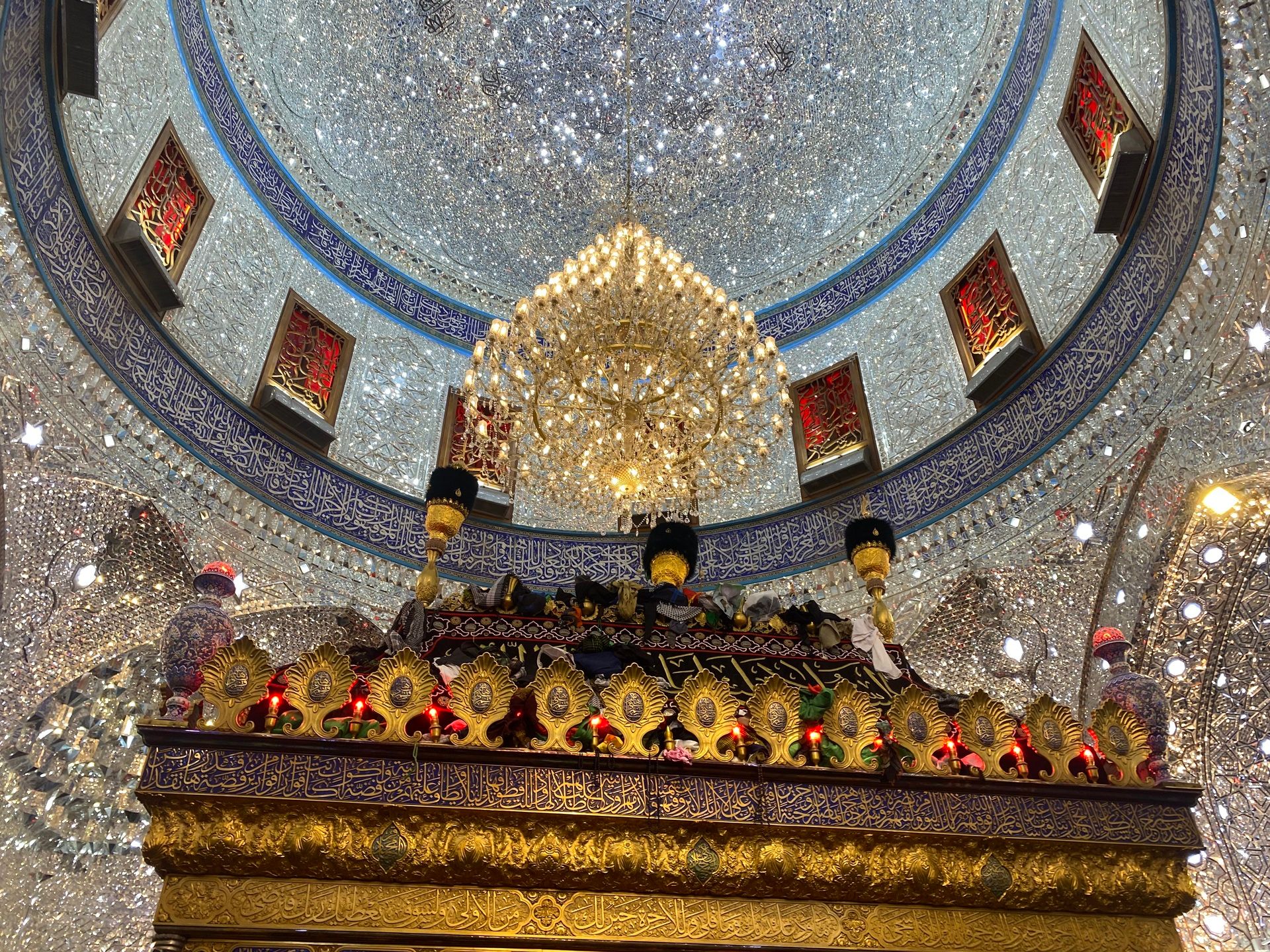
It’s hard to put into words the beauty of these shrines. After days of walking and simple living conditions, they stand as places of pure extravagance. The gilded ceilings, crystal chandeliers, calligraphy, and polished marble underfoot were something to behold.

Yet their power isn’t only in appearance. Inside, people arrive dusty and exhausted, but with their souls awakened. Some spend hours in prayer, some sleep on the carpets, some just weep. I saw many rise with renewed faith with commitments to justice, to kindness, and to carry something meaningful back into everyday life.
Closing

My first two week in Iraq left my head and heart full. I received an unending flow of kindness and generosity. I confronted how different our views of a place can be from reality. I was immersed in an environment that felt wholly unfamiliar and welcoming at the same time.
With Love,
-Adam
If you like these stories and would like to lend your support, you can become a monthly contributor on my Buy Me a Coffee page. Donations will go to support my efforts to give back to others as I travel.
Gratittude to my current supporters:
-
John Lyne
-
Tiana Tymko
-
Steve Cox
-
Roy Tymko
-
Riley Santarossa-Dixon
-
Sandy Bos
-
Riley Santarossa-Dixon
-
Dustin Ouellette