
Opening Notes
This is Part 2 of my Shifting Grounds series, where I’m exploring why our world feels increasingly uncertain. In Part 1, we looked at that strange ache many of us feel—the sense that something fundamental isn’t working. If you’re new here, you can start with any post, but they build on each other.
The End of Pretending
If you’re still here, maybe you’ve felt it too—the persistent, penetrating ache that points to a world out of balance.
Once we begin to sense that something fundamental isn’t working, it’s hard to return to comfortable ignorance. The veil, once thinned, doesn’t thicken again so easily. What once passed for normal now feels increasingly absurd, unsustainable, or even surreal.
These aren’t just isolated breakdowns we’re witnessing. Our institutions are failing to address the crises they were designed to handle. Our economic systems create more inequality while claiming to lift everyone up. Our political structures promote division while promising unity. Our healthcare systems treat symptoms while ignoring root causes. Our educational institutions prepare us for a world that no longer exists.
What appears as surface cracks may go down to the foundation—not just of our systems, but of our collective understanding of reality itself.
An Acceleration into the Unknown
It’s not controversial to say our world has problems. We all know this. Wealth distribution is grotesquely unequal, wars rage on, corruption goes unchecked. But what happens when the flaws run so deep they can’t be easily repaired? What happens when cracks spread faster than we can patch them?
What feels unique about our moment is that we’re crossing multiple thresholds simultaneously.
Consider the timeline: In less than five years, we’ve seen a global pandemic reshape society, AI exceed capabilities that were once science fiction, climate records regularly shattered, democracies strain toward authoritarianism, and economic inequality reach feudal proportions. Each crisis arrives before we’ve fully processed the last one.
We’ve moved beyond warnings into unprecedented territory, yet we’re still using the same language and logic as before. We’re still trying to solve twenty-first-century problems with twentieth-century thinking. These challenges are no longer contained by geography or easily reversed by policy.
The rules are changing faster than our institutions can adapt. So much around us carries existential weight. I don’t see this as gradual decline but as phase transition.
The Breakdown in Plain Sight
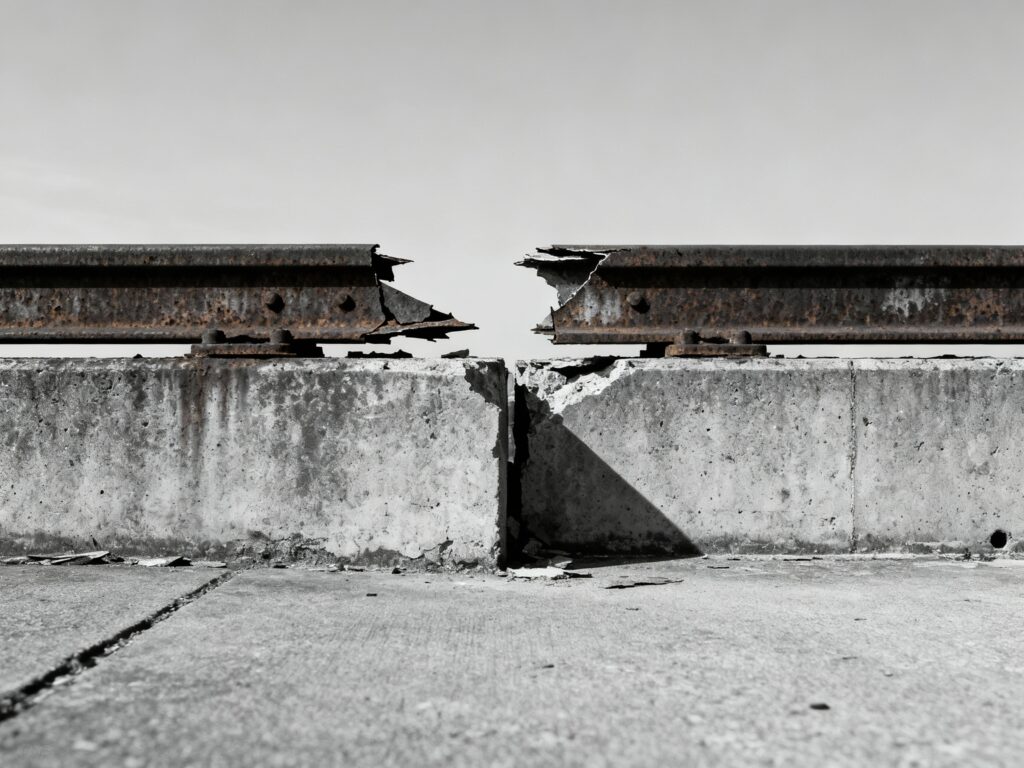
The deeper we look, the more we see. We’re stepping into uncharted territory while pretending our old maps still work:
Ecologically, we’re witnessing species extinction, soil depletion, and ocean acidification at rates never seen in human history. The biological foundation of civilization is dissolving in real time. 1
Technologically, advancement outpaces our ability to adapt or regulate. AI became mainstream just a few years ago, and already we can’t distinguish real videos from fake ones. We’re creating tools we don’t understand with consequences we can’t predict.
Economically, wealth concentrates upward at unprecedented rates. The richest 1% captured nearly two-thirds of all new wealth created globally since the pandemic. The gap isn’t just growing—it’s accelerating.2
Socially, we’re losing our sense of what it means to be part of a community. Extended families have scattered, and our screens increasingly replace genuine human connection. We’re more networked but more isolated than ever before.
Physically, we’re poisoning our bodies, soil, and food with chemicals that didn’t exist a generation ago—microplastics, forever chemicals, endocrine disruptors. Male sperm counts have dropped by 50% in just a handful of decades3. Women’s hormones have been similarly disrupted. We’re literally changing what it means to be human.
Mentally, our psychological health is collapsing, especially among young people. Suicide rates, anxiety, depression, and addiction are all rising. Maybe this isn’t pathology, but a rational response to an irrational world.4
The Global Perspective
This breakdown isn’t equally distributed. The Global South bears our externalities—the hidden costs of maintaining our systems. Climate disasters, resource depletion, debt servitude, and endless conflicts enable our air conditioning and next-day delivery. What we call “development,” others experience as extensions of colonization.
The Performance of Normalcy
Despite these visible fractures, we’re told things are manageable—that a global summit, new leadership, or policy reform will bring us back on track. We’re also told we can fix how we feel by doing our part: recycling, buying another wellness product, or attending a retreat. Yet we return to the same systems that cause our dis-ease. We skim the surface while the depths remain unexamined—both collectively and within.
The dominant narrative says we just need to adjust, optimize, and adapt. Yet something inside knows this requires more than lifestyle changes. It’s systemic. The mismatch between how we feel and what we’re told creates a dissonance that many fill with distraction, cynicism, or numbing. Social media has become our digital soma, providing the illusion that infinite scroll can satiate infinite overwhelm.
While many feel this tension, few express it.
It’s All Connected
At first glance, everything seems separate: health crises, technological disruption, political turmoil, ecological breakdown. But what if these aren’t many problems but symptoms of one wound—a system out of balance, a culture disconnected from nature, spirit, and authentic self?
I believe this is tied to our collective level of consciousness. We’ve made incredible leaps in tools and technology but lack the wisdom to wield them responsibly. We’ve developed the power of gods while retaining the emotional maturity of teenagers who think they know everything but really understand very little.
All of this points to a breakdown in the story we tell about the world. Not a fiction, but a worldview—the lens through which we interpret reality. Currently, we’re operating with a dangerously narrow perspective, both spatially and temporally. Nations think only of themselves while every action creates global ripples. We plan in four-year election cycles and climate agreements just a few decades out while the consequences of our decisions will echo for countless generations.
We’re like passengers rearranging deck chairs on the Titanic, optimizing what we can perceive while the hull takes on water beneath us.
When It Feels Too Big
Opening our eyes to these connections is like opening Pandora’s box—they don’t close easily once opened. It’s natural to feel overwhelmed when we start seeing these patterns. The human brain evolved for village-sized problems, not planetary-scale crisis.
Our responses fragment accordingly. Some retreat into tribal blame, pointing fingers at convenient scapegoats. Others escape into materialism and consumption. Still others bypass the difficulty by ascending into the spiritual while avoiding the messy work of being human.
But what’s important is that we don’t have to bear the full burden individually. We can’t single-handedly fix the world’s problems, but we can step out of willful ignorance. Simply seeing clearly can be revolutionary in a world drowning in illusion.
Why We Resist Looking
We sense these truths but resist facing them. Beneath the resistance lies our fears. We fear losing what we know, entering the unknown, and accepting that our cherished beliefs were built on cracked foundations. To really see this is to acknowledge that we need radical transformation.
Collectively, the devil we know feels safer than the angel we don’t. Like someone who stays in a toxic relationship because it’s familiar, we’ve grown comfortable in our collective dysfunction, even as it consumes us from within.
We’re afraid of what change would demand—what sacrifices in comfort, predictability, and convenience we’ll need to make. But when these are built on a crumbling foundation, change may not remain optional much longer.
Perhaps we’re also afraid of what we’re truly capable of as human beings. Our intuition knows this truth, but we’ve been trained to doubt inner knowing in favour of external authorities.
There’s also learned helplessness. These issues seem too large, complex, or entrenched for individual action to matter. So we keep our heads buried while convincing ourselves that ignorance spares us pain.
Finally, there’s privilege. Many of us benefit from exploitative systems, even as they steal the foundation from others today and from all future life. Like an addiction, facing our complicity requires a humility that feels overwhelming.
Why We Must Look
Yet, if we want to create possibility for change, we need the courage to face what’s clearly in front of us. The alternative to seeing clearly isn’t comfort—it’s being blindsided by accelerating collapse.
Looking at what lies before us isn’t about guilt or shame; it’s about waking up to what’s actually here. As Carl Jung observed, “Until you make the unconscious conscious, it will direct your life and you will call it fate.”
We can’t delegate our decision-making to the same power systems that created these problems. This is about choosing awareness over comfort, consciousness over complacency.
My Own Path Through
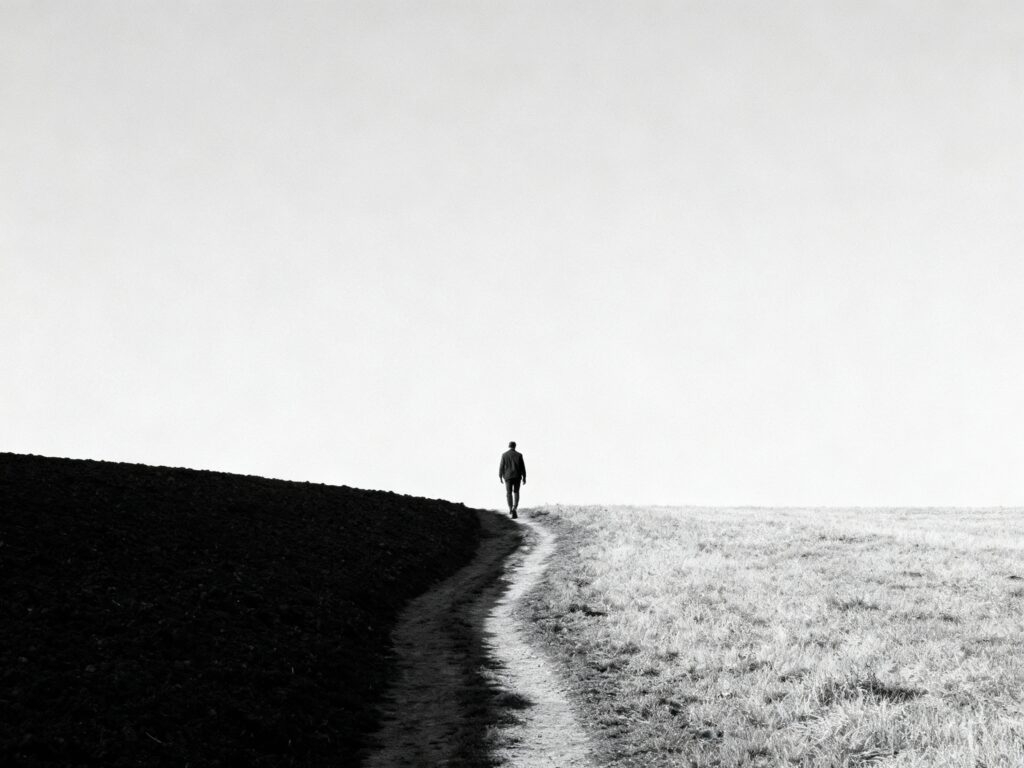
I’ve found this to be true in my own journey. Each time I’ve leaned into discomfort—whether through days in silent meditation, leaving behind a predicable life, or confronting uncomfortable realities about the world—it’s initially difficult and I often want to retreat. But each time I come through, I feel my spirit expand, my sense of self deepen, and my aliveness return.
I still have far to go on this path. Many days, I feel like a toddler learning to walk—stumbling forward a few steps, then falling down. Sometimes I cry, but I get back up. I no longer measure progress by distance traveled, but simply by the direction I’m facing.
Practical Invitations
If you’re still with me but don’t know where to begin, I’d suggest dipping your toe into discomfort rather than diving into the deep end:
Learn to listen to your body and heart. Develop a practice of asking what your body is telling you, especially when it conflicts with your rational mind.
Practice connecting with yourself through meditation, yoga, breathwork, or movement. These are pathways to deeper listening.
Cultivate connection to something greater than yourself. You may call this shared humanity, Mother Earth, God, Allah, The Divine, or a myriad of other names.
Peek at the difficult truths, but don’t stare. Nietzsche warned that if you gaze long into the abyss, the abyss gazes back into you.
Start asking better questions. “Who benefits from this story?” “What’s not being said?” “Is this the whole picture?”
Diversify your information diet. Seek out perspectives you disagree with to understand where others are coming from. This is especially crucial in an age of algorithmically bespoke echo chambers.
Express what you feel, even if it’s unpopular. You don’t need to shout from rooftops, but finding regular release can ease inner tension.
Leave room for wonder. The most profound insights often emerge from the unknown.
Make ritual of time in nature. If screens distort our perception, natural spaces can restore our deeper knowing.
These may seem small, but revolutionary thoughts often begin with subtle shifts in awareness.
The Cracks Let Light In
I don’t write to scare. I write because I care. Not just for myself, but for all beings on this planet and the countless generations yet to come.
I hold onto hope. Not blind optimism, but the kind that comes from walking through darkness and discovering what emerges on the other side. Perhaps this is what Jesus meant when he said “unless you turn and become like little children, you will never enter the kingdom of heaven.”
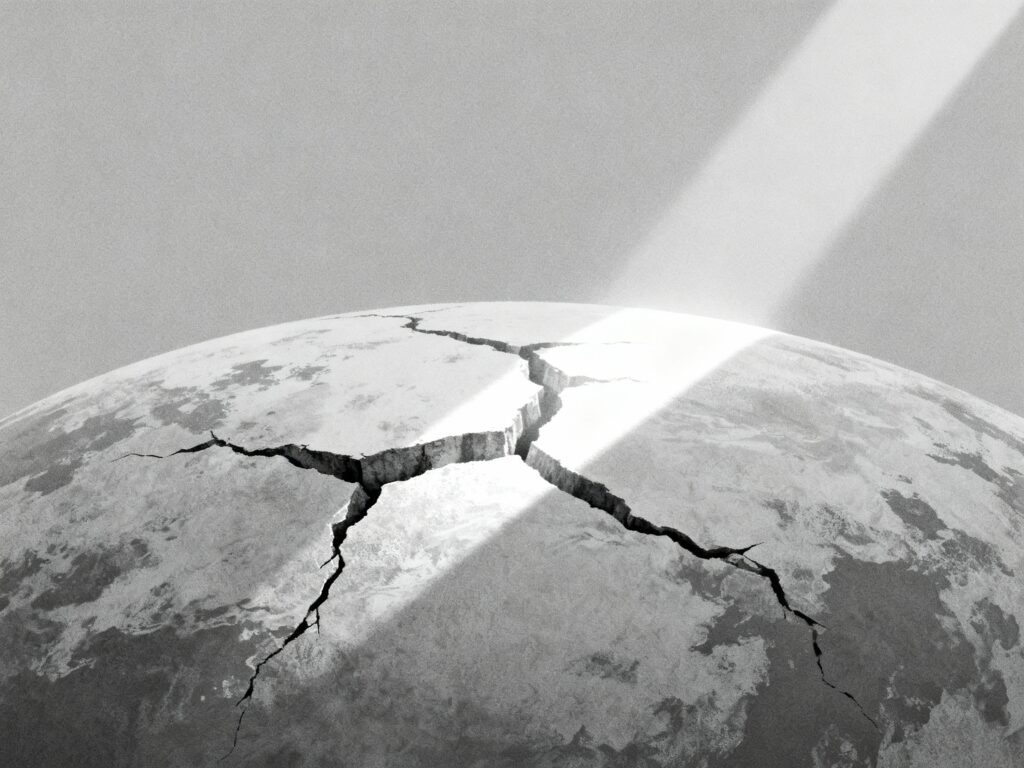
We’re venturing into our collective shadow so we can return more whole. The cracks we see aren’t just signs of ending, but are where light shines through to reveal truth, illuminate injustice, and awaken deeper knowing. They create space for a new story that resonates with both heart and soul.
Hope is revolutionary while despair is a luxury we can’t afford. If the cracks signal collapse, then the crumbling becomes our teacher and, eventually, our midwife for whatever new wants to be born.
Breakdown and breakthrough are often the same phenomenon seen from different angles. The Chinese character for crisis includes both danger and opportunity. We’re living through the most precarious moment in human history—and the one most ripe with possibility.
Most importantly, we get to participate in what comes next.
Walking Forward Together
The cracks show us where the old story is breaking and where a new one can emerge. I don’t claim to have answers, but I believe the path of inquiry, humility, heart-centred feeling, and truth-telling matters deeply.
And we don’t have to walk this path alone.
This is an invitation to explore together, to connect the dots, to make sense of this moment that seems to be asking everything of us while offering everything in return.
The foundation is shifting beneath our feet. Rather than frantically trying to anticipate the next crumble, perhaps it’s time to learn how to dance with the uncertainty and help bring forth the best version of what might emerge.
Journal prompts: What illusions might we need to release to live more fully and honestly? What would it mean to trust your inner knowing as much as external authorities? What would shift if you stopped pretending everything was normal?
next post
- https://www.science.org/doi/10.1126/science.1246752 ↩︎
- https://www.oxfam.org/en/press-releases/richest-1-bag-nearly-twice-much-wealth-rest-world-put-together-over-past-two-years?utm_source=chatgpt.com ↩︎
- https://hormoneslongview.com/testosterone-levels-are-declining/ ↩︎
- https://www.edweek.org/leadership/why-america-has-a-youth-mental-health-crisis-and-how-schools-can-help/2023/10 ↩︎
1 thought on “The Cracks We Can’t Unsee”
Adam,
It’s nice to hear from someone who has similar concerns for the world and hopes for our future. It’s hard to know what to believe when the media we consume is so biased by our algorithms. My parents often have a completely different idea of what’s going on in the world. I like that you highlight the importance of seeking out other perspectives, but also not spending too much time contemplating difficult truths. None of us can solve the world’s problems on our own and getting dragged down in pessimisim leaves one feeling paralyzed. I hope you enjoy your retreat!
Take care,
Patrick