
Two years ago, I visited India for the first time. I came hoping to find spiritual spaces but was quickly swept into the chaos that defines this country. During that trip, I took part in a 10-day Vipassana silent meditation retreat, which left me wondering why I had traveled halfway around the world to sit in silence. The unending noise of the cities made me question how so many people reported finding peace here. There’s a saying that felt true: India doesn’t give you what you want, it gives you what you need.
Though challenging, I found myself returning often to the lessons from that visit. There is something unshakable about the depth, paradox, and diversity of this vast country. That trip taught me that beginning to understand India takes time.
Now, with time on my side, I’ve returned. I’ve started to tap into the flow that breaks down rigidity. My intention for this stay is contemplation and a deeper understanding of Eastern philosophy—without any timeline or expectation of where the lessons might come from.
India in Monsoon
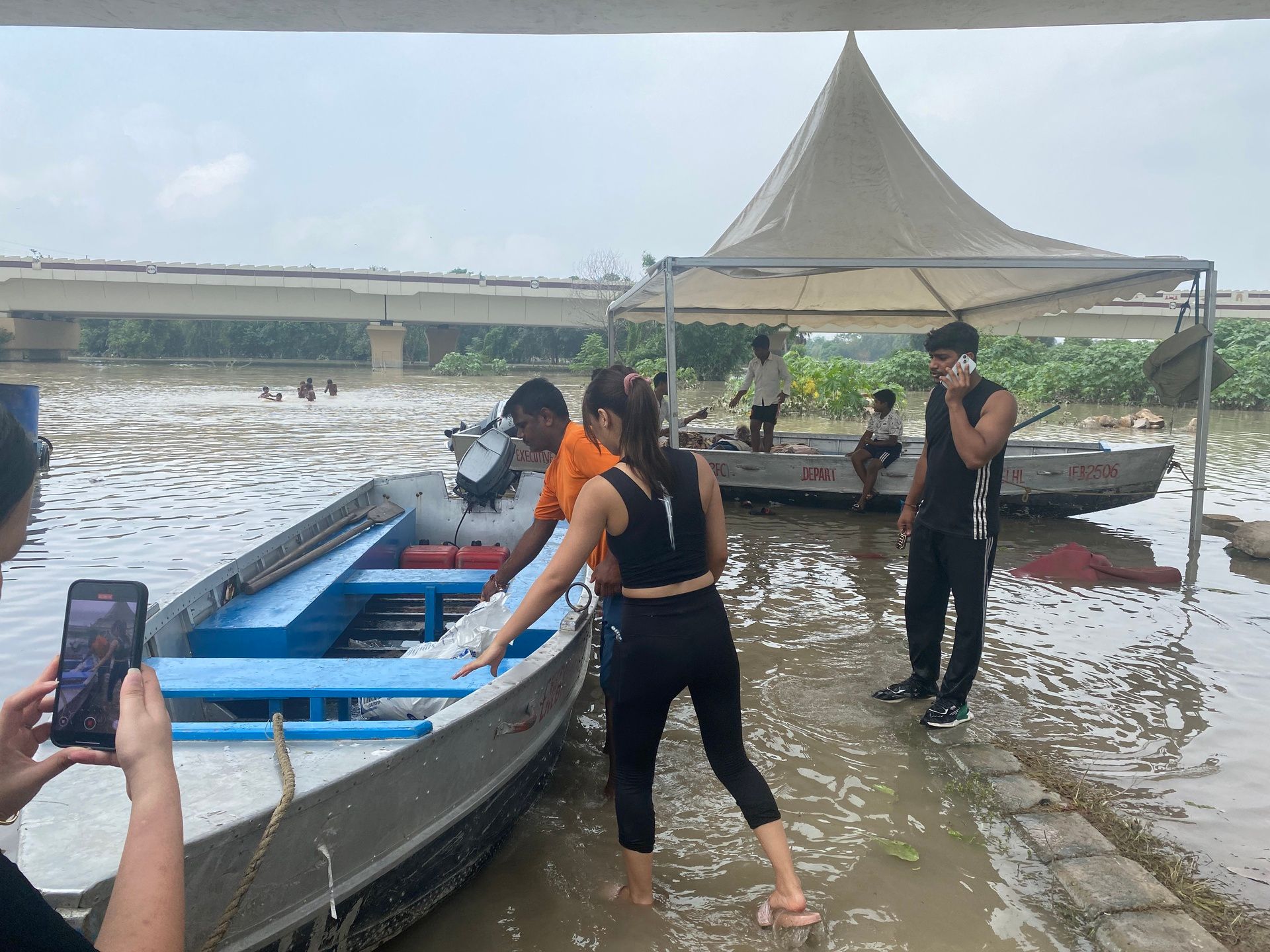
This year, India was hit by a record-breaking monsoon season, and I arrived just as it was winding down. Roads were flooded, buildings washed away, and entire communities were without electricity. This wasn’t limited to remote areas—I saw boats navigating what should have been roads in Delhi. This again highlighted how much of the world’s problems are faced by those with the least, while many of us scroll through life insulated by modern advances and privilege.
When I landed in Delhi, I was invited to join a mission to feed stranded dogs. I hopped on a boat where there once was a road, setting out into murky water to help where we could. Jetlagged and running on minimal sleep, I admittedly wasn’t of much help, but this certainly marked a steep and sobering re-entry into India.

Relief tents within Delhi.
I found relief tents set up for families whose homes were swallowed by the floods. Despite the dire circumstances, I saw children laughing and playing in the nouveau mires—a reminder that mindset is a choice, even amidst hardship.
Deohari Valley

Almost a year ago in Bolivia, I met Ky, a Brit living in Northern India. He told wondrous stories of a remote area he had discovered, painting it like a fairytale—dense greenery, rolling hills, and a close-knit community largely untouched by visitors. Now, being “in the neighbourhood,” I decided to take him up on his offer to stay for a while.
From Delhi, I took some questionable mountain roads north, meeting Ky at his home in the remote Deohari Valley in Himachal Pradesh.
I wasn’t prepared for what awaited. After 10 hours of driving and a couple of hours hiking up a mountain, we arrived in a remote landscape I hadn’t imagined possible in India. The honking horns were replaced by the hum of birds and cicadas, the air crisp, surrounded by Himalayan foothills. This wasn’t the India most people know.

Days passed leisurely as I spent time with friends, meditating and soaking in the nature around me. I fell into a routine guided not by clocks, but by natural rhythms—sleeping with the sun, doing outdoor workouts, exploring the region shared by people, plants, and animals, feeling distinctly removed from the world’s rush. After months consumed by city life in dry, hot Morocco, Jordan, and Iraq, returning to cooler, greener, quieter surroundings was a welcome change.

Ky and I on a supply run, navigating the washed out roads.
Admittedly, there were trade-offs. Electricity and internet were intermittent after the heavy monsoon, supplies required long trips to the nearest village, and rides back often involved sitting on top of jeeps.

Riding in the back of a jeep up to my village in the Deohari Valley.
Living here for a month showed me another slice of life on this massive planet. Things don’t run nearly as efficiently as back home, but for me, that was the point. These friction points bring people together and are reminders to slow down. The trade-offs were worth it for the peace I found.
Following the Sainj River
I met some locals who invited me on a week-long trek deep into the Sainj Valley within the Great Himalayan National Park. Never one to miss an adventure, I eagerly accepted.

We packed our bags with the essentials and followed the Sainj River as far as it would take us.

Aman and Ujjwal, my Himachalan friends and hiking partners for the journey.
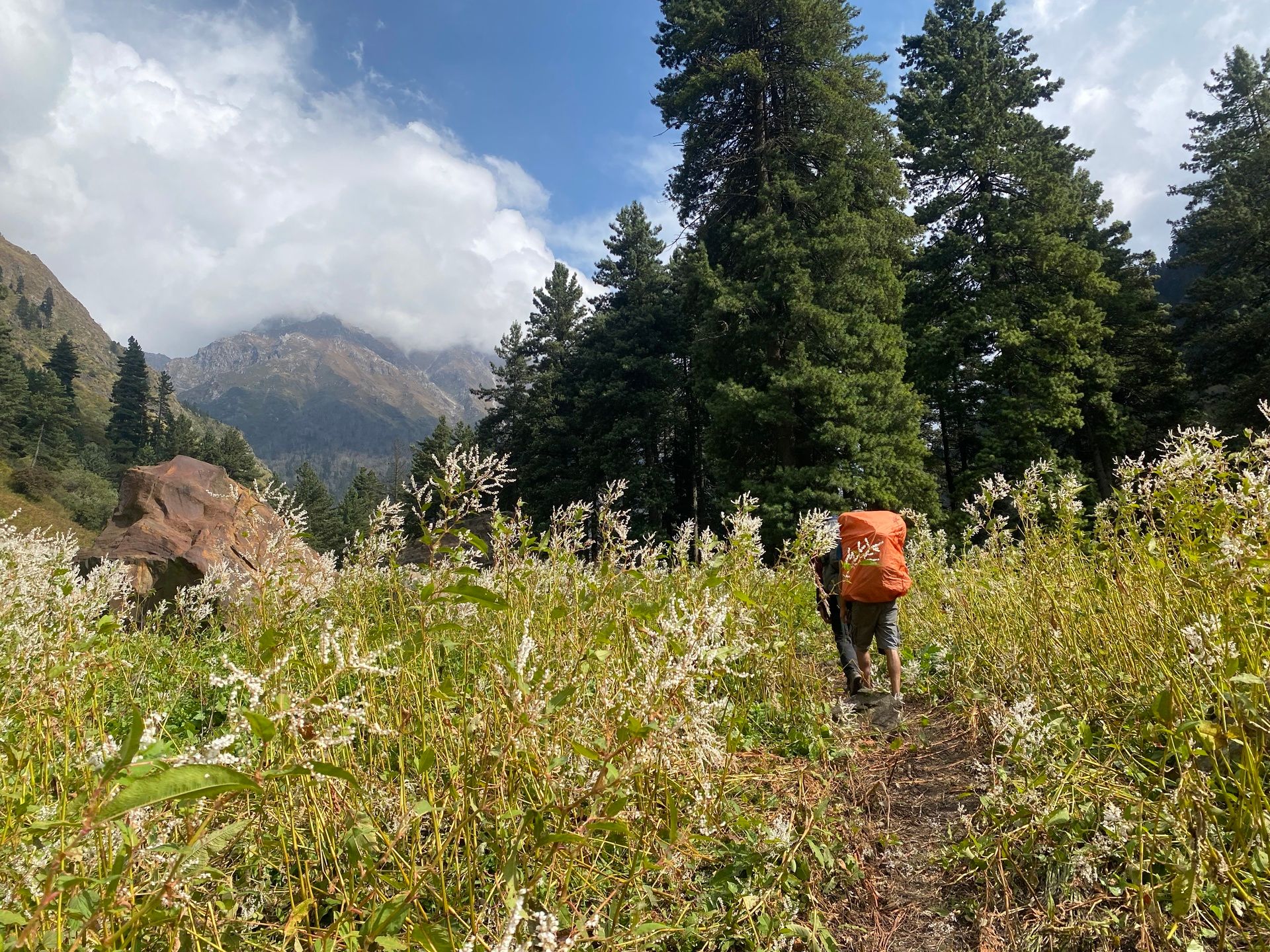
After the monsoon, the trails were free of people but bursting with life.

Following the river, we climbed higher and higher along the pristine Sainj River. With little human footprint around, all water was safe to drink; we filled our bottles with fresh Himalayan runoff.

At one crossing, we used a self-propelled cable car system, guided supportively by a local.

The monsoon rains washed away many of the paths and crossings. The locals were quick to rebuild with make-shift bridges made from fallen trees.

These bridges may not pass an engineering inspection, but they added to the wild charm of the hike.

During the first two days, we passed remote villages—likely some of the world’s most isolated. I was told some houses were over 100 years old. People lived simply, washing clothes outdoors beside their goats and sheep.

I met a family whose main house had been swept away by a recent landslide. They now lived in a shelter meant for their animals. It was a sobering reminder of how different life can be, and how much we take for granted.

Few people were on the trails, mostly locals. We passed a family who had just sacrificed a goat at a deva statue (a sacred monument), and I saw the remains left at the altar. While animal sacrifice is rare in mainstream Hinduism, it persists in folk traditions like those here in the remote Himalayas.
Ujjwal, familiar with these rituals, suggested we cook the goat’s feet as a snack. Knowing this opportunity was rare, I obliged. It was simple but tasty, especially with a bit of added salt.

Our final destination was Raktisar, a sprawling meadow high in the valley. The snowcapped peaks that once seemed far on the horizon now opened up before us. This was the edge of the vast Himalayas.
It was a rare moment—standing in an untouched landscape that has existed since time immemorial. A deep peace settled within me as I realized that despite humanity’s many problems, places like this still exist and will long outlast us. They feel sacred because they put so much into perspective.
Dharamshala

From the Sainj Valley, I took an overnight bus to Dharamshala, a center for Tibetan Buddhism and the home of the Dalai Lama in exile.

Monks creating a sand mandala—a work of art destroyed after completion to symbolize life’s impermanence.
Seeing so many red-robed Tibetan monks and nuns for the first time was powerful. Monasteries here are prolific and welcoming to visitors. I’d watched many documentaries about their traditions, and now they were playing out in front of me.

The Sharbling Monastery near Bir, India
A major reason for returning to India was to delve deeper into Buddhist philosophy. I look forward to the weeks I’ve booked at a Buddhist institute this December.
Bir, Bikes, and Bros

Connor, Richard, and myself in Bir before Paragliding
I quickly befriended Connor and Richard at a hostel in Dharamshala. We decided to rent motorcycles and head to Bir, a nearby town, for a paragliding adventure.

A Hero XPulse 200 Motorcycle
This was my first time back on a bike since my first backpacking trip in Vietnam seven years ago. Nostalgia flooded over me as I wound through mountain roads, feeling a sense of freedom I hadn’t known in years.

Bir is world-renowned for paragliding—an accessible price (~40 CAD) and stunning views make it a sought after destination.
Closing

This return to India was a stark contrast to my first trip two years ago, overwhelmed by big cities and a tight schedule in a new land. Now, knowing where to go to find what I sought, I’ve seen a completely different side of this vast country.
India especially rewards those who give it the time to reveal its diverse beauty. I plan to spend many more months here, diving deeper into Buddhist and Hindu philosophy.
With Love,
-Adam
If you like these stories and would like to lend your support, you can become a monthly contributor on my Buy Me a Coffee page. Donations will go to support my efforts to give back to others as I travel.
Gratittude to my current supporters:
-
John Lyne
-
Tiana Tymko
-
Steve Cox
-
Roy Tymko
-
Riley Santarossa-Dixon
-
Sandy Bos
-
Dustin Ouellette
-
Jamie Rose