
After a bit of a hiatus, I’ve finally found the space to reflect on my time trekking in Nepal. I always sit down thinking it’ll be a short update, and then remember just how much can happen in a few weeks on the road.
Over the summer, my friend Adam (yes, another Adam) invited me to join him on a multi‑week trek in the Everest region of Nepal. I was already planning to be in India, so it was an easy “yes”.

Adam and I first met in Vietnam on my first trip seven years ago. He made a remark about a suit I was trying on, realized we were both Canadian, and became travel friends in passing from there. We stayed in touch over the years with our shared interest in personal growth and travel. He even set off on a similar journey when he was my age, and his advice has supportively nudged me along more than once.
Now, years later, one casual invitation brought me to Nepal—a reminder of how small moments can ripple into something much larger.
The Trek Plan

The Streets of Kathmandu
I’ll be honest: I did very little of the planning for this trip. When Adam invited me, he also offered to handle most of the logistics, which I was grateful for, especially since I was still mid-way through my Middle Eastern travels.
There are many ways to trek in Nepal’s Khumbu (Everest) region. Some people opt for a one-week sprint to Everest Base Camp, flying directly into Lukla to save time. Others choose longer, slower routes that take weeks. You can fly or you can endure some truly questionable ground transport to stay on a budget — which is what we did.
We chose one of the longer, more traditional routes: starting where the early Everest pioneers once did, before roads and flights made access easier. From there, we completed the full Three Passes Trek, a high-altitude circuit that loops around the Everest massif. It’s considered challenging, but also one of the most accessible and stunning treks in the world.
For those wondering: I did not summit Everest. That’s a pursuit reserved for a very particular mix of courage and recklessness. Only around 7,500 people have ever reached the top, largely due to the immense physical toll, risk, and cost (often upwards of $100,000 CAD).
Our journey unfolded in two main legs: Jiri to Namche, a quieter, less‑traveled section that slowly climbs from the lower foothills into Sherpa country, and then the Three Passes Trek, a high‑altitude circuit that includes Everest Base Camp and surrounds you with some of the most remarkable mountains on Earth.
The Route (250km in total)

Leg 1 (Jiri to Namche Bazaar): 125 km, 15,000 m ascent. Average altitude: ~2,500 m.
Leg 2 (The Three Passes Trek): 150 km, 14,000 m ascent. Average altitude: ~4,000 m.
A list of all our stops along the way:
Jiri – Shivalaya – Bhandar – Sete – Junbesi (Thupten Choling) – Nunthala – Kare – Cheplung – Manjo – Namche Bazaar – Pangboche (Ama Dablam) – Chukhung (Chukhung Ri) – Lobuche (via Dingboche) – Gorak Shep – Drag Nag – Gokyo (Gokyo Ri) – Thame – Namche Bazaar – Surke – Salleri – Kathmandu.
Costs and Details
(Costs in CAD)
By global standards, trekking in Nepal is quite affordable. All in, it cost about $50 per day, including food, accommodation, permits, ground transport, and a bit of gear I picked up along the way.
Costs can climb quickly depending on comfort level. Flights to Lukla add roughly $300 each way, and extras like hot showers, charging devices, WiFi, laundry, guides, and porters all come at a premium—services we mostly skipped.
Prices rise steadily the higher you go, simply because everything must be carried up by mule, yak, or porter. Adam and I tracked what we jokingly called the “dal bhat index”—rice and lentils with unlimited refills, served everywhere. It was usually the cheapest and most filling option. In Jiri, it cost about $3. At the highest elevations, closer to $15. Everything else followed a similar curve.
There’s a lot more I could say about planning and logistics, but many guides already do that far better than I could. I’ll link a few of the resources Adam used below and focus here on the experience itself.
-
Jiri to Shivalaya: https://www.green-lotus-trekking.com/jiri-to-shivalaya/
-
Jiri to Namche Bazaar: https://www.magicalnepal.com/travel-guide/everest/everest-base-camp-trek-permit/
-
Solo hiking the Three Passes Trek: https://nicholaseager.com/guides/how-to-solo-hike-the-three-passes-trek/
-
Detailed Three Passes trekking guide: https://www.goingthewholehogg.com/everest-three-passes-trek-guide/
-
Three Passes video: https://www.youtube.com/watch?v=QtLPRUjvWog&t=3662s
-
Full documentary of the trek: https://www.youtube.com/watch?v=RoP8VNq0MME&t=383s
Part 1: Jiri to Namche

Shivalaya Village
The journey began with a 4 a.m. wakeup and a ten‑hour, stomach‑turning bus ride from Kathmandu towards Jiri. The moment we left the city limits, the road fractured into potholes and dirt. We were lucky to find seats; the bus soon filled beyond capacity, with people standing in the aisles and hanging onto whatever they could.
Barf bags were handed out and used often, though somehow Adam and I emerged unscathed. The locals seemed unfazed, chatting, laughing, and going about their day as upbeat folk music blared from the speakers.
We rolled into Jiri in the early afternoon with enough daylight to hike up to Shivalaya, about nine kilometres and mostly uphill. After hours of being rattled around on the bus, our legs felt wobbly, and within fifteen minutes we were both out of breath. Thankfully, our bodies adjusted quickly, and over the next few days our pace picked up.

Those first days served up sweeping views of rolling foothills and quiet valleys. Most days we’d see only a handful of other trekkers on this stretch. Decades ago, these trails were the main route into the Everest region, but most people now fly directly into Lukla and skip this extra week of walking.
Looking back, this section was, in many ways, the most enjoyable. The air was still thick with oxygen, the weather was warm, and it often felt like we had the trail to ourselves.

One of my favourite parts of trekking in Nepal is the teahouse culture. Throughout the foothills and mountains, small villages host simple guesthouses where locals have turned part of their homes into lodgings for travellers. It’s a bed‑and‑breakfast model that offers a warm bed, hot meals, and, crucially, the chance to hike light without camping gear or food.
The villages themselves have a quiet beauty. Homes are built with care, often in sturdy stone and wood, painted in an eclectic mix of colours that stand out against the green hillsides. You can feel the pride in the craftsmanship.
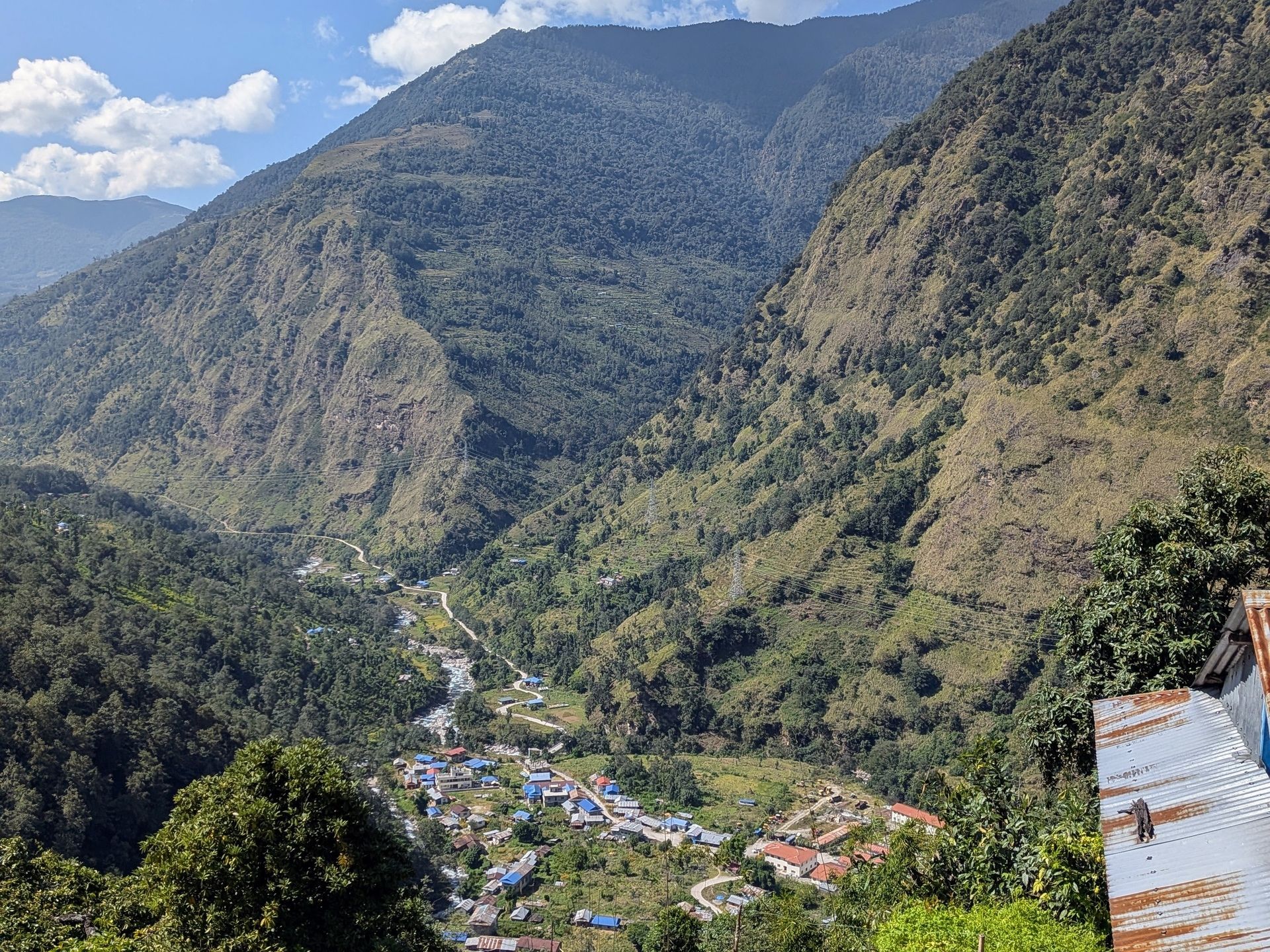
The hospitality matched the surroundings. We were welcomed with a warmth that went beyond transaction—it rarely felt like we were buying a room so much as being invited in as guests.

The gradual ascent hinted at what awaited us higher up. Some days we climbed as much as 1,500 m, the sun beating down and sweat stinging my eyes.
My trick to stay fuelled was a stash of Snickers and Dairy Milk bars—over twenty‑five of them to start. I don’t normally crave that much chocolate, but in a steady calorie deficit, they disappeared quickly.

Everest is there… somewhere.
Near Nunthala, we caught our first glimpse of Everest. There were still more than 100 km between us and Base Camp, but seeing that unmistakable silhouette on the horizon felt surreal. It marked a distinctive shift from abstract idea to something real, looming out there ahead of us.

Along the way we passed countless Tibetan Buddhist monasteries, stupas, and prayer flags, reminders that we were walking through sacred land. Seeing monasteries perched high on ridges and built into remote valleys added to the landscape’s mystique.

With my growing interest in Buddhism, I tried to visit as many monasteries as I could. At one, we met a 20‑year‑old American who was spending a year as the only foreigner studying with the monks. He invited us to attend a funeral ceremony.
We sat quietly at the back as monks of all ages chanted and played a cacophony of horns, drums, and cymbals to guide the departed soul onward. It wasn’t a performance for visitors, but a real ritual unfolding in front of us—the kind of moment I used to only glimpse through documentaries.

Our days slipped into a simple rhythm with early starts, steady walking until early afternoon, then slow evenings with books and card games. The 125 km from Jiri to Namche Bazaar took us nine days, a rollercoaster ascent from 1,500 m to 3,500 m.

We met plenty of characters along the way. One guy was biking from Kazakhstan and determined to pedal all the way to Base Camp. Many teahouse owners were retired Sherpas who had guided successful Everest summits and now shared their stories over tea.
Then there was Mitch, 84 years old, making his way along the same steep paths. He’d been to the region more than a dozen times and joked, almost reluctantly, that he might finally be “getting too old for it.” He was a walking reminder of just how tenacious the human spirit can be.

Past the village of Surke, on the final approach to Namche, the feel of the trail changed. The narrow dirt paths widened and became stone‑paved. Trekkers who had flown into Lukla merged onto the route, and their numbers multiplied.
The quiet gave way to the sounds of peak‑season tourism and the earthy smell of animal droppings from long trains of yaks and mules hauling supplies up and down the valley.

Many yaks were spotted along the way.

It’s worth pausing to acknowledge the people who make all of this possible: the porters. All the way up, we saw men carrying loads that made my small backpack look comically light—stacks of plywood, rebar, gas canisters, crates of food—often roped together and balanced with a strap across their foreheads.
Many walked bent forward under the weight, inching up the steep paths for modest pay. Watching them work put my own struggles into perspective and made it hard to complain about any discomfort I was feeling.

Namche Bazaar, 3500m
We reached Namche Bazaar, “The Gateway to Everest,” just as a major storm rolled in. The unseasonal system (Cyclone Montha) would later make headlines for bringing some of the heaviest recorded snowfall to Everest in recent history. We weren’t in a rush, so rather than push into unpredictable conditions, we decided to wait it out for a few days.

While we waited, I took a day hike up to the nearby village of Kunde, hoping for another clear view of Everest. Low clouds kept the peaks hidden, but they made space for a different kind of encounter.

Walking through the village, I met a Nepalese man who introduced himself as Charok. He explained that he’d just come from Lawudo Monastery, where he was teaching Buddhist courses to an international group. He mentioned that he studied Buddhist psychology and practiced Buddhist counselling, which was more than enough for me to ask if we could sit for tea.
He welcomed me into his home, where his wife and mother‑in‑law were cooking potato pancakes for lunch. Over tea and food, he shared pieces of his life growing up in monasteries in Nepal and India, and how families in the region endure the long winters.
There is no central heating; fires are lit in the evenings for cooking, but otherwise people live in homes that can sit at minus twenty degrees with minimal insulation. Any complaints I have as a Canadian about winter suddenly felt small.
I mentioned that I was heading to India to study Buddhism at the Root Institute, and he laughed, saying he would also be there around the same time to teach a course.
What he didn’t add—and what I later learned from a nun—was that he is a Lama, a revered spiritual teacher often recognized as the reincarnation of a previous master. As a child, he had been identified as the reincarnation of a Nyingma yogi who had spent decades meditating in a cave in this very region. I still don’t know why our paths crossed that day, but it felt deeply synchronistic.

On the way back down to Namche, the clouds settled low in the valley, a reminder of just how high we were perched in the mountains.
Part 2: The Three Passes Trek
Once the storm cleared, the skies opened up and stayed mostly blue for the rest of our time in the region. We set off toward Pangboche to begin the Three Passes Trek.
This second leg was more demanding and, in many ways, more special. The altitude rose, the temperatures dropped, and the amenities thinned out. We moved more slowly and felt the kilometers more deeply, but that also made each day’s progress more satisfying.

Ana Dablam
Soon we found ourselves walking through a white world, snow stretching out in every direction.
We passed beneath Ama Dablam, a striking peak known for its twin humps and elegant profile. Everest may be the famous one, but Ama Dablam was the mountain that kept pulling my eyes back. Over a couple of days, we circled around it, seeing new angles and facets with each step.
Well above 4,000 m, the air felt thinner and my backpack heavier. Distances that had flown by on the first leg now dragged on, with more frequent breaks and slower, more deliberate steps. Still, I enjoyed feeling my body being pushed to its limits.

Villages of Dingboche, Pengboche, and Tangboche can be seen in the valley.
Our first big climb was to the Chukhung Ri viewpoint at about 5,600 m—the highest I’ve ever been. At that altitude, the air holds roughly half the oxygen it does at sea level. We climbed 800 m over just 3 km, with almost no switchbacks, which meant four straight hours of steep ascent on slick snow. By the end, I was stopping every fifteen steps to catch my breath, legs burning and lungs protesting.
Whenever I felt the urge to complain, I reminded myself that Everest’s summit sits another 3,000 m higher. Anyone attempting that has to endure a whole different level of discomfort.
Reaching the top of Chukhung Ri gave us a panoramic view that no photo could capture—a ring of Himalayan peaks all around, with the valley below tracing the villages we’d walked through in the days before and a clear line where the snow began.

Yakland Teahouse in Chukung at twilight.
The teahouses became a nightly refuge after long days out in the cold. With no trees and no natural gas at that altitude, a single metal stove in the dining room burned yak dung as fuel.
Trekkers would gather around the fire in the evenings, faces windburned and sunburned, eyes heavy with fatigue. We shared stories, ate simple but delicious meals, and usually headed to bed around 8 p.m. The local families, well‑accustomed to the conditions, served us with quiet kindness and an understated Tibetan humility.

/im
Adam and I found ourselves making many passing friends on the trails, some of whom we joined for a few days, including Antony and Meghan from Alaska.
We had originally planned to cross the first pass, Kongma La, but recent heavy snowfall and the cumulative fatigue from over 150 km of walking nudged us to take an easier route instead of adding another gruelling ascent.
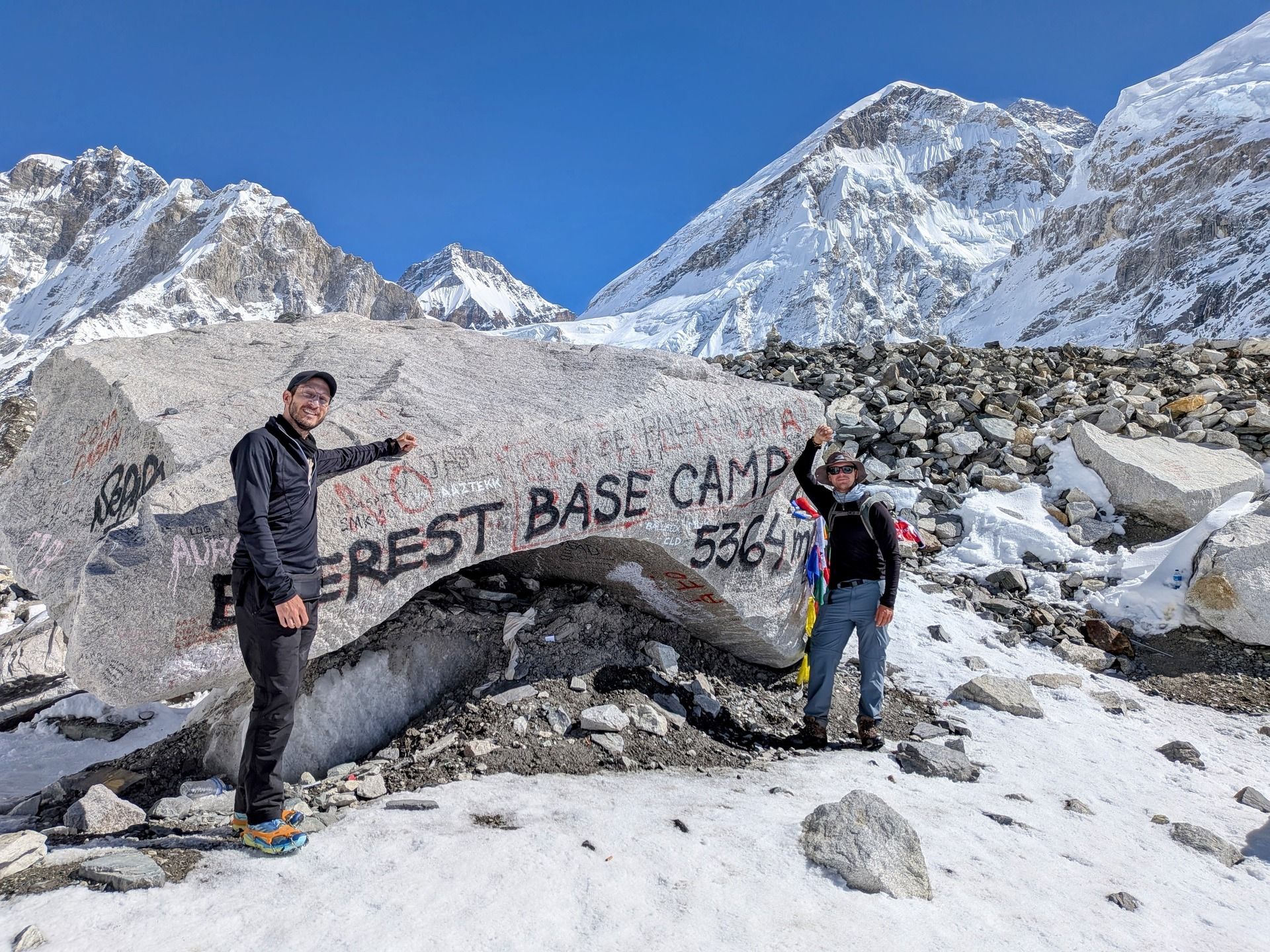
Everest Base Camp, 5364m.
From Chukhung, we dropped back onto the main trail leading toward Everest Base Camp. This turned out to be the most underwhelming part of the whole trek. We were again surrounded with a hoard of other trekkers on their “Base Camp sprint”, and settlements above 5000m meant freezing nights with the bare minimum in terms of comfort.
Visiting Base Camp outside of the main climbing season (April and May) meant arriving at a single painted rock marking the famous spot—no visible camp, just a label on a frozen landscape. Any we found that only a small sliver of Everest is visible from Base Camp.
Even so, standing there felt meaningful. It marked the endpoint of more than two weeks of effort, and that alone was worth celebrating.

In Gorak Shep, the settlement nearest to Base Camp, we ended up in one of the more infamous accommodations on the circuit, the subject of many travellers’ horror stories on their way back down.
Our room felt closer to a dungeon than a guesthouse with a snow‑filled window, flickering light, and the faint smell of mildew in our bedding. Nighttime temperatures dropped below freezing, so I slept in as many layers as I could, waking up to find ice crystals in my water bottle. Still, it wasn’t the worst place I’ve slept on this journey, and I was grateful for four walls and a mattress.

Kala Patthar, 5500m.
Later that evening, we climbed Kala Patthar for sunset views of Everest. The ascent was short but steep, and the cold at the top was, in Adam’s words, “cold as balls.”

An unforgettable sunset view of Everest.
Once the sun dipped low and lit the peaks in warm light, most of the discomfort faded into the background.

Thanks for the amazing experience, Adam.
After two long weeks of early mornings, heavy packs, and a persistent “Khumbu cough”, Adam felt his journey was complete and decided to begin his descent. I chose to carry on and finish the final two passes.

Cho La Pass, 5420m.
The next morning, I set off alone, though “alone” is a relative term on these trails. I tend to talk to most people I meet, and it didn’t take long before I was walking alongside new friends.
Crossing the Cho La Pass brought another dramatic shift in landscape. Fresh snow had carved a narrow path between jagged peaks, creating one of the more memorable mornings of the trek.

Crossing the Ngozumpa Glacier.
Later that day, I crossed the Ngozumpa Glacier, the longest glacier in the Himalayas. Unlike the smooth white ice fields I’d seen in Patagonia, this glacier was a jumble of rock, ice, and meltwater, weaving through a maze as I made my way down and back up. Under the midday sun, the snow on the trail turned to slush, and I kept punching through with almost every second step.

Gokyo Lake
When I finally reached Gokyo, I knew instantly it would be one of my favourite stops of the trip. The village sits beside a crystal‑clear, turquoise lake that reflects the surrounding peaks. On the rest day I took there, the sky stayed a deep blue, and the open views in every direction made me forget that a busy world was going on beyond.

A view from the top of Renjo La Pass, 5360m.
The final big push was over the Renjo La Pass before before making my way down. A series of false summits tested my patience and legs, but the top offered one last stunning view of Everest and its neighbours, which felt like a proper farewell.

From Renjo La, the descent back to Namche came quickly. After so many days at high altitude, I was ready to see grass and trees again, to breathe air that didn’t feel quite so thin. I passed a few more monasteries on the way down, trying to soak up as much as I could before dropping back into the world of roads and chaotic rhythms.

After nearly four weeks of trekking, it felt good to be nearing the end. The return to Kathmandu was its own mini‑adventure. It was a final two full days of jeeps and buses jolting over the same rough, narrow roads I’d taken on the way in.
Closing
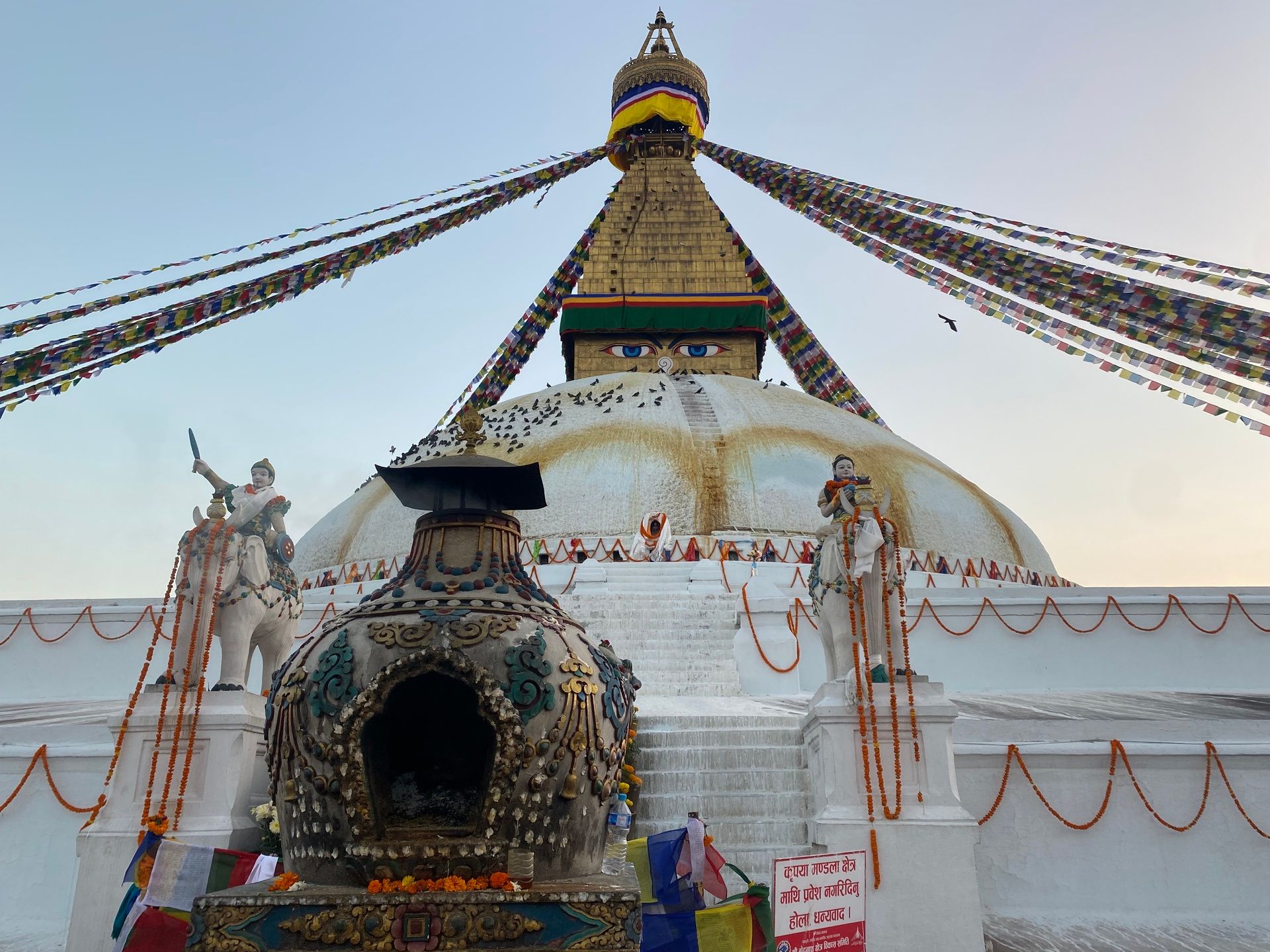
Coming near the end of the year, this really sealed in 2025 as a year overflowing with adventures—hitchhiking across Chile and Iraq, hiking in Patagonia and the Indian Himalayas, joining millions of Muslims for the Arbaeen pilgrimage, and now walking in the shadow of Everest. It’s hard to find enough words for how grateful I am to have the chance to do all of this.
I’m now on a motorcycle journey through India, and as I reflect on the last seventeen months, I feel like I’ve more than met my quota of “big adventures” for a while. The question that keeps arising is: what comes next in my life?
I don’t feel fully ready to return or settle down, but I do feel called to go deeper inward—to explore questions like “How can I use my life in service?” and “How can I cultivate a deeper relationship with the force that moves through all life?”
If there’s one thing I keep learning, it’s that the most beautiful lives rarely follow a neat script. They’re shaped by uncertainty, detours, and the willingness to step into the unknown without guarantees. It’s less about reaching a fixed destination and more about staying honest my heart’s intent, again and again.
For now, I’m continuing to move with the quiet trust that if I follow those inner nudges, I’ll keep arriving where I’m meant to be.
Thank you for continuing to walk alongside me in these stories. I hope some part of this nudges you to step a little further outside your comfort zone, embrace uncertainty, live courageously, and make room for the full richness that life is offering you.
With Love,
-Adam
If you like these stories and would like to lend your support, you can become a monthly contributor on my Buy Me a Coffee page. Donations will go to support my efforts to give back to others as I travel.
Gratittude to my current supporters:
-
John Lyne
-
Tiana Tymko
-
Steve Cox
-
Roy Tymko
-
Riley Santarossa-Dixon
-
Sandy Bos
-
Riley Santarossa-Dixon
-
Dustin Ouellette
-
Doug Finkelstein
-
Jamie Roase
-
Cliff Ruben