
My time in Morocco has come to an end, and the road continues eastward. After a few months of structure and routine, I’m back in traveller mode which means more movement, more sights, and unknown places.
Before I even began this journey, I had my sights set on the Middle East – a region so often misunderstood in the West. I told myself that if I truly wanted to understand the world we live in, this was a place I had to see for myself. I knew there was more than the skewed headlines of war. It’s a region of of deep history, diverse culture, and remarkable hospitality.
My first stop was to Jordan – a small, stable country that began to open my eyes in ways I didn’t expect. In my short nine day visit, I found ancient architecture, incredible food, and a warm culture that welcomed me in.
A Quick Visa Hop to Faro, Portugal

Before Jordan, I had to extend my Moroccan visa. I booked the cheapest weekend flight I could find: $40 to Faro, Portugal.
Jumping from Morocco to Europe came with a surprising dose of culture shock. I’d grown used to the flow of life in Morocco. Suddenly, I was surrounded by music on the streets, beers flowing freely, and people dressed far less modestly. I felt old senses come alive. It reminded me how quickly we adapt to our environment. Even something that once familiar can suddenly feel foreign.
The “Seven Hanging Valleys” hike stole the show. The trail hugs the seaside cliffs, offering amazing views the entire way.
After months in dry, dusty Marrakech, this hike was a breath of fresh air (literally). The deep blue of the sea, the patterned cliffs, and the wafting scent of the trees revitalized me in an unexpected way.
Saying Goodbye to Morocco

The Hassan II Mosque, Casablanca
Three months in Morocco taught me a lot, but it was time to move on. Inshallah, I’ll be back.
Amman, Jordan

Moving on with my travels, Jordan proved to be a great entry point into the Middle East. Landing in Amman, I found myself again in a new part of the world. The Middle East is often painted in broad brush stroked, but here the cultures are layered and constantly surprising.

Around Amman, the ruins of ancient empires are everywhere. I wandered through the roman theatres and crumbling citadels, all dating back 2000 years.

I noticed how these past empires built for beauty and longevity, and found myself wondering at what point we strayed from this.

Jamal, a new friend from Algeria
One of the best parts of travel for me is meeting people. In Amman, I met Jamal from Algeria, a chef who insisted on cooking me dinner. We scrounged together ingredients from the hostel kitchen and he turned them into a delicious pasta. My French was broken, his English non-existent, but somehow the conversation still worked.
That night I learned something about “offering etiquette”. In parts of the Islamic world, if you compliment something, the person may actually offer it to you. I mentioned liking Jamal’s shirt, and though it was too small for me, he insisted I take one from his son. He wouldn’t take “no” for an answer.
Many of the people I’ve met have also extended sincere invitations to come and stay with them in their countries. From this leg alone, that includes Algeria, Tunisia, Qatar, Belgium, and Germany. I hope one day I can take them up on it.
Petra

The Treasury, 40m / 128 feet tall
Petra is one of the main attractions that brings people to Jordan. It’s one of the Wonders of the World and it deserves the title. Most people know it from the towering Treasury and its cameo in the Indiana Jones Holy Grail scene. But the site hold so much more…
Fun fact: the ‘Treasury’ never actually held treasure. It was most likely a royal tomb.

What makes Petra truly unique is its architecture. Every building, tomb, and cave was carved into the the sandstone cliffs. It wasn’t built, but sculpted.
Petra isn’t just a cluster of building, but was once a thriving desert city. And maybe just as impressive as the buildings themselves was how they managed to secure access to water. The Nabataeans laid kilometers of underground pipes, channeling water from the nearest spring into the depth of the city – a system that sustained them for hundreds of years.

The Monastery. See if you can spot the donkey for scale.
After several kilometers of winding trails, I reached the Monastery. The trek makes it less visited than the Treasury, but that’s part of what makes it special.
I spent two full days wandering Petra and still didn’t see it all. I was surprised by how open it was to explore. Aside from a ‘no entry’ sign at the Treasury’s doorway, there’s really no limit to where a visitor can go.
Wadi Rum Desert

From Petra, I continued my way South to the Wadi Rum desert. Tourism was quiet, which made finding a camp last-minute tricky, but also meant I had long stretches of desert nearly to myself.
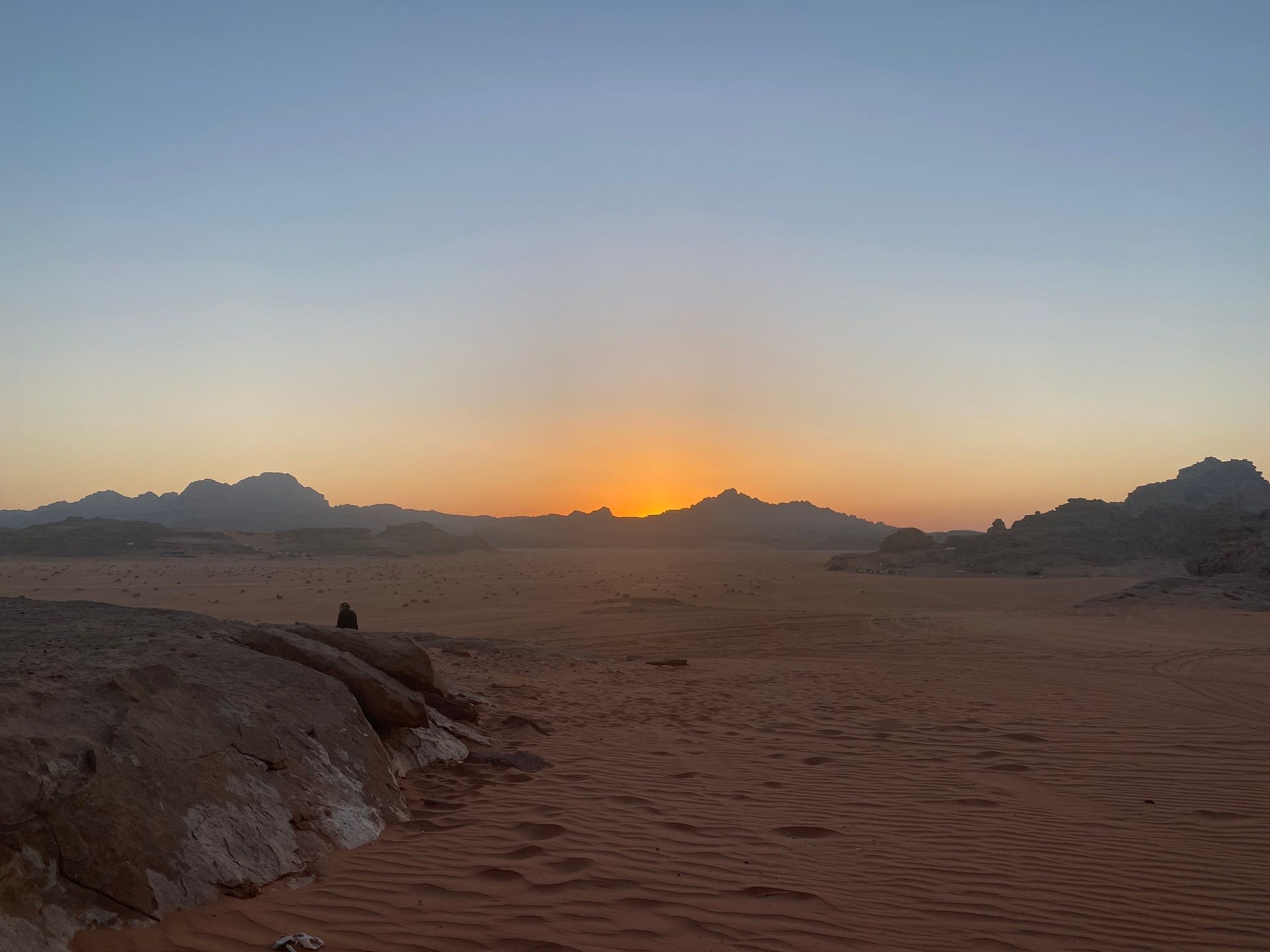
Unlike the dunes of the Moroccan Sahara, Wadi Rum is a mix of mountains and sand. It’s a Martian-like landscape of red earth, towering rock formations, and near-total silence.

During the days, I set out with a water bottle and no plan but to roam. The slick sand made the going slow, but without a fixed destination I didn’t mind. My mind drifted from the beauty around me to the little thoughts that creep in anywhere like what I’d do back at camp, whether to book a jeep tour, or what my next project is.
These days, instead of fighting those thoughts, I just notice them and return to the present.

One afternoon I scrambled up a rock face until I found a perch between two mountains. With no wind, no vehicles, and no animals, it felt like true silence – just the faint ringing in my ears. It was perfect; there was nowhere else I wanted to be. It made sense why people have always sought solitude in places like this.

At night, I set out again to watch the stars. Again, I found myself peacefully alone with the distant stars as company.
Schenanigans with New Friends

Abdullah, Ahmed, and myself at the Wadi Mujib Bioshpere Reserve
A friend from Canada connected me with Ahmed, a Jordanian local, and his group of friends. They welcomed me instantly, covering almost every expense and refusing to let me pay. “Next time, in Canada,” they said.
One day we drove to Wadi Mujib, a gorge near the Dead Sea. We donned life jackets and water shoes, wading against the current through narrow canyons. Sunlight hit the rock walls, fish nibbled our toes, and on the way back we just let the river carry us downstream, staring up at the strip of sky overhead.

Later we made it to the Dead Sea. It’s the lowest walkable place on Earth at 400 metres below sea level. Ten times saltier than the ocean, the water makes sinking impossible. Floating there felt like being a kid again discovering a new law of nature.
Reflections on Palestine

A Palestinian family that I met while at a gas station.
Jordan borders Palestine, much of which is illegally occupied by Israel. It felt uncanny being this close to the ongoing crisis I’d grown used to seeing on my phone every day. While I continued to enjoy my travels and the richness of my experiences, many are suffering unjustly just a short distance away.
While here, I met many Palestinians. Some had relocated, while others were temporarily escaping the weight of life under oppression by the Israeli Government . Seeing their faces and hearing their stories made the headlines and images I’d been scrolling past feel truer, heavier. It was no longer something I skimmed over with a fleeting thought, but a reality lived by the people sitting across from me.
Here’s just one story I wrote in my journal, from a man I sat next to on a bus crossing Jordan.
I met a Palestinian man today while leaving the Red Sea. I learned that he was returning home – to a place that no longer resembled what he once knew. His face told more than any words could. He didn’t speak English. Nor I Arabic. But with screen as translator, we had an exchange – brief but powerful.
I learned he worked with disabled children and had brought 30 kids over to the beaches of Aqaba for a temporary reprieve from life in the West Bank. What for me was just another beach was, for them, an escape.
He explained that 400 homes had been destroyed in his village of Tulkarm while children continue to starve in Gaza. I searched for a response, but didn’t know what to say. There are only so many ways to translate: “I’m so sorry.”
then he showed me his phone. WhatsApp and Instagram reels filled with dust and rubble. I imagine if this had happened in my community, how deeply I would feel hurt. thoughts of “Where do they live now?” and “How will this end?” played through my head.
I asked him what myself and others in Canada could do to lend support. “It’s the governments that enable this; people need to put pressure on them” came across the screen. He wasn’t asking for money or a handout, but for our collective voice to grow louder.
He also mentioned the inhuman treatment his family would face when crossing back over. The IDF and Israeli authorities that control these areas don’t hide their view of Palestinians as lesser – and here I could see the toll it takes.
More than any words, his expressions spoke for him.
It was the way he lay slumped in his seat,
looking out at the passing landscape with frequent sighs.
It was the nervous checking of his phone.
It was the look of resignation and helplessness he gave me during our translated exchange.
During the ride, I was organizing pictures from my trip – Petra’s ancient stonework, desert landscapes, shared meals with friends. Yet beside his reality, those images felt drained of colour. I saw myself chasing another sunset memory to be recounted later, while next door families like his live without dignity or basic certainty.
How do I reconcile this? I don’t see it as needless guilt, but a continued call to change how I travel and live with new-found insight.
It’s something to sit with.
I tried to put myself in his position, but struggled. He was right next to me, but our lives are so different. This at least felt like another step in understanding the ways we live and circumstances we find ourselves in.
If you would like to support this man and his community, you can consider donating to an effort to rebuild their community here.
Closing
I’ve seen how easily we misunderstand this part of the world, and how different the reality can be. Not far beneath a surface of differences is a shared humanity that I keep finding wherever I go. My hope is that we all find our way to discover this for ourselves.
Now, I’m sitting in a cafe in Iraq, watching crowds flow past in one of the biggest gatherings on the planet – the Arbaeen Pilgrimage where more than 20 million Shia Muslims meet to pay respects to Immam Hussein. With heart and eyes wide open, I’ve found unity and connection here and look forward to sharing more in another update.
With Love,
-Adam
If you like these stories and would like to lend your support, you can become a monthly contributor on my Buy Me a Coffee page. Donations will go to support my efforts to give back to others as I travel.
Gratittude to my current supporters:
-
John Lyne
-
Tiana Tymko
-
Steve Cox
-
Roy Tymko
-
Riley Santarossa-Dixon
-
Sandy Bos
-
Riley Santarossa-Dixon
-
Dustin Ouellette